Why Meditation Gets Harder
When meditation gets harder, the resistance you feel isn’t a sign that you’re doing it wrong. It’s the energy moving into places that have been dormant. As the subtle body awakens, it begins to clear what has been stored there: old tension, unprocessed emotion, the quiet weight of a life lived on autopilot.
With any cultivated meditation practice, the nervous system recognizes the rhythm, the space, the seat, and the posture. The transition into stillness becomes almost automatic. And when meditation gets harder, it is this practice that quietly holds the practitioner.
Patanjali’s Yoga Sutras name this abhyasa: steady, uninterrupted practice over a long time (Sutra 1.14). The ancient texts speak to what arises along the way. The Hatha Yoga Pradipika describes impurities that obstruct the nadis (energy channels). Yogic traditions also describe granthis, energetic knots associated with obstructions to the movement of prana. As one continues to sit over months and years, these are among the deeper patterns that may begin to reveal themselves through sustained practice.
Sometimes, a practitioner who once loved meditation begins to lose interest in sitting because there can be periods of discomfort during meditation. The body speaks first. Your legs twitch. Your hands find something to fidget with. Your mind races through the day’s unfinished business, and before you know it, you’re mentally writing emails instead of sitting with yourself. This restlessness isn’t necessarily a failure of discipline. It’s the subtle body adjusting to the attention you’re finally giving it. Much like a muscle that trembles when you ask it to work after years of disuse.
Restlessness, physical tension, heaviness, or difficult inner states begin to arise. Without necessarily recognizing why, the practitioner starts avoiding the very practice they once treasured.
This resistance is when meditation gets harder and is worth exploring. What appears to be a loss of interest may actually be an unwillingness to encounter what is emerging in the stillness.
Every meditator comes upon this. Areas of the body begin to tense while sitting. Move, and the tension or pain leaves. Meditate, and the discomfort returns. Within the framework of subtle-energy, this can be understood as something long held within the system beginning to surface through meditation.
This is why meditation gets harder. Importantly, it is not because the practice has failed, but the opposite. The blockages have risen or surfaced to meet you. We call this cooking, the cosmic fire of intensity starts to bring these things that don’t belong to the surface.
These are not necessarily places we move through by pushing harder. In my experience, sustained meditation allows us to gradually encounter and work through what is crystallizing. Regularity carries us through.
This discomfort can take years to move through though. This is where doing inner work with what arises in meditation can be especially helpful. By exploring the underlying material rather than simply enduring the discomfort or quitting, we can begin to move through these difficult periods and find greater ease in our practice.
The Mundane Face of the Work
There is a tendency, especially for those who enter deep states easily, to want to present the practice at its best. To show up with the beautiful sits and the clear spaces.
But the real material for transformation lives in the discomfort when meditation gets harder. The tension in the body, the irritation that arises, the flatness of consciousness, the sleepy consciousness that cooks out, and the resistance that shows up as restlessness or heaviness. Importantly, these are not failures.
Within the yogic understanding of subtle energy, they may be experienced as obstructions of past issues surfacing, asking to be seen and worked through.
This can show up in ways that seem almost mundane. One suddenly fidgets, can’t get comfortable, and may even begin to lose interest in meditation altogether. The mind starts to wander where it had previously been still, the body rebels, and the practice that once felt effortless now feels like a chore.
This is not a sign of regression. It is part of the awakening. The cooking, the fire working through what is crystallizing, burning it out of the human system.
Even the loss of interest in one’s meditation is material to sit through. Especially that.
This is where the practice becomes unglamorous. The visions fade and the insights settle. What remains is the simple, unglamorous act of showing up again and again to the same seat and the same restless mind. This is the mundane face of the work, and it is the most important part of the practice. It is where the structure is built, sit by sit, even when nothing seems to be happening.
Sitting versus Moving Meditation
The mundane face of the work isn’t only in the mind. It’s in the legs that ache, the back that complains, the body that says “get up.” This is often where people move into a moving meditation such as walking, gardening, and lying down.
Here those things are wonderful, contemplative and much needed. But they are different from what happens when you stay with the sitting. When you stay, you meet the resistance directly, you let the energy move through the body instead of around it. Walking and gardening can soothe and settle, but they also let you leave the discomfort. Sitting doesn’t. It asks you to stay with it and cook the system.
The Good News
Meditation resistance and discomfort during meditation are not signs that you’re failing. They’re signs that the practice is working and that something real is being touched. When the practitioner stays with the discomfort instead of avoiding it, something shifts. The restlessness settles, pain doesn’t become central, fidgeting softens and the mind stops racing quite so hard. What felt like a wall begins to reveal itself as a doorway.
This is the good news: the harder it gets, the closer you are to what you’ve been avoiding. The resistance isn’t an obstacle to the practice. It is the practice. The discomfort is something to sit with and move through you. And when you do, the subtle body does what it’s been trying to do all along: it clears, it opens, it fortifies and strengthens.
The practitioner who once dreaded sitting begins to understand. The wall wasn’t a wall. It was the edge of something deeper and on the other side of the resistance is the very peace they started meditating to find.
Bringing It to the Work
When something arises in your meditation such as discomfort, emotion, reaction, restlessness, or resistance, pay attention to it. These experiences can reveal where deeper inner work is waiting. Just in the seeing alone can bring levels of awakening.
There is an opportunity to up your meditation practice and sit longer when restlessness arrives. To watch something cook on the stove top. It sizzles. The image below shows a posture Baddha-Padmasana that helps one sit in stillness when one is sizzling.
I remember my Teacher observing me struggle and putting me somewhat (haha) in this position. It was incredibly helpful.
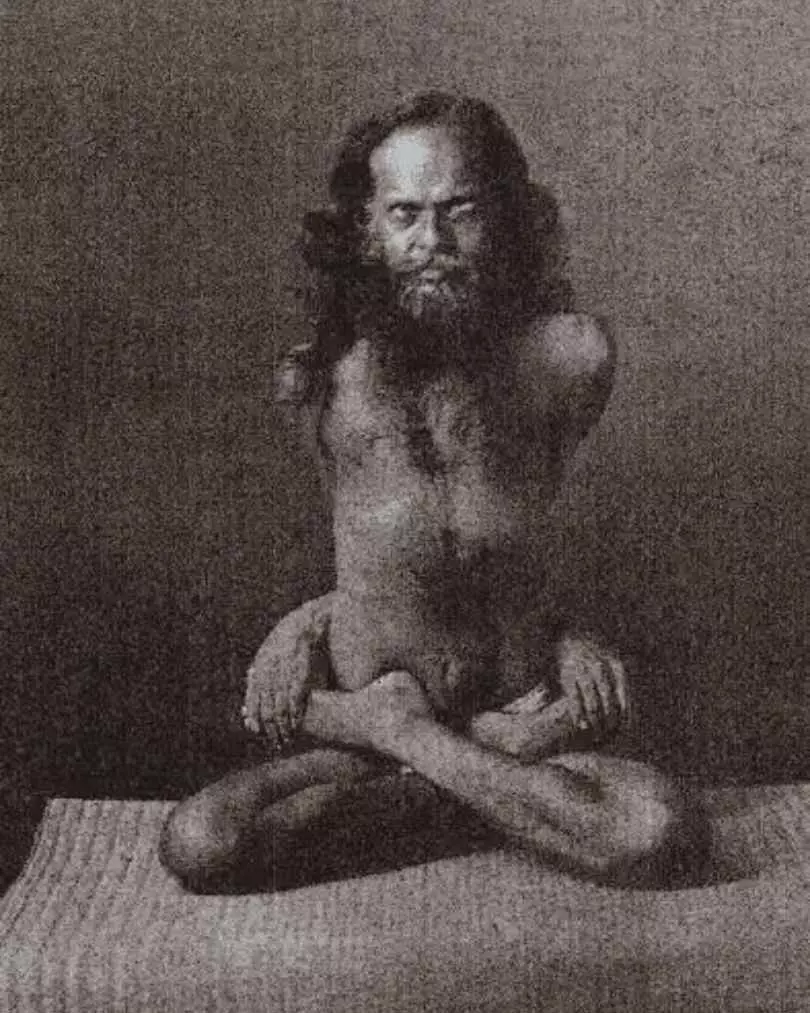
Baddha-Padmasana Asana Posture
And I will call out the elephant in the room. This yogi looks a little crazy or highly intense shall we say. Note the ultimate fire coming through him. I have seen this in my Teacher and while it is scary, at least for me, it feels incredible to be in a presence like this.
You don’t have to navigate these difficult periods alone. Energy work and meditating with others helps a great deal.
The beauty of the states we encounter in meditation can be what draws us back to the seat. Yet the discomfort that arises along the way is also part of the process. Both belong in the practice. Both belong in the room.
And when you’re ready to explore a practice that builds the structure to hold all of this, a yogic meditation on the central channel, the docking station is where that begins. Read reflection →
Written by Elle Kerr-Wilson, founder of Amplify Your Light in Edmonds, Washington. Meditation Mentor/Guide and Sacred Vision Embodiment Healer guiding seekers in the Seattle area and worldwide online.
Explore Sacred Vision Healing →
Learn about Meditation →
Continue the Exploration
If this reflection resonated with you, you’re welcome to receive occasional writings on meditation and inner transformation.